
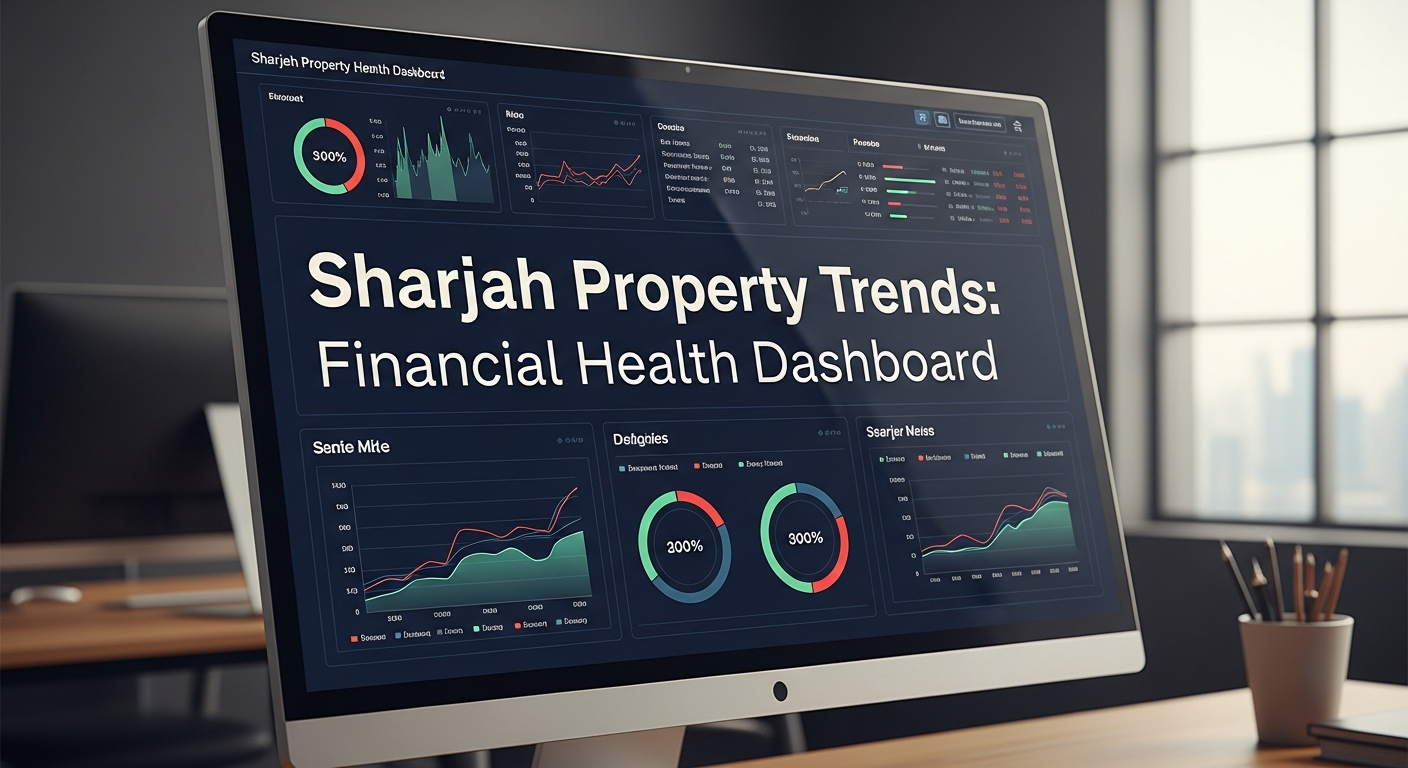
To gain insight into future direction in the Sharjah property market, one has to look beyond current prices and recent sales data. Today’s investors are using much more advanced analytics to help make investment decisions; and of all of the analytic tools available to them the financial health dashboard is among the most powerful. The financial health dashboard brings together many indicators into a single view for buyers and investors to assess how well each area of the emirate is doing.
How the Financial Health Dashboard Reveals Sharjah Property Market Trends
Financial health dashboard – what it is and how it works
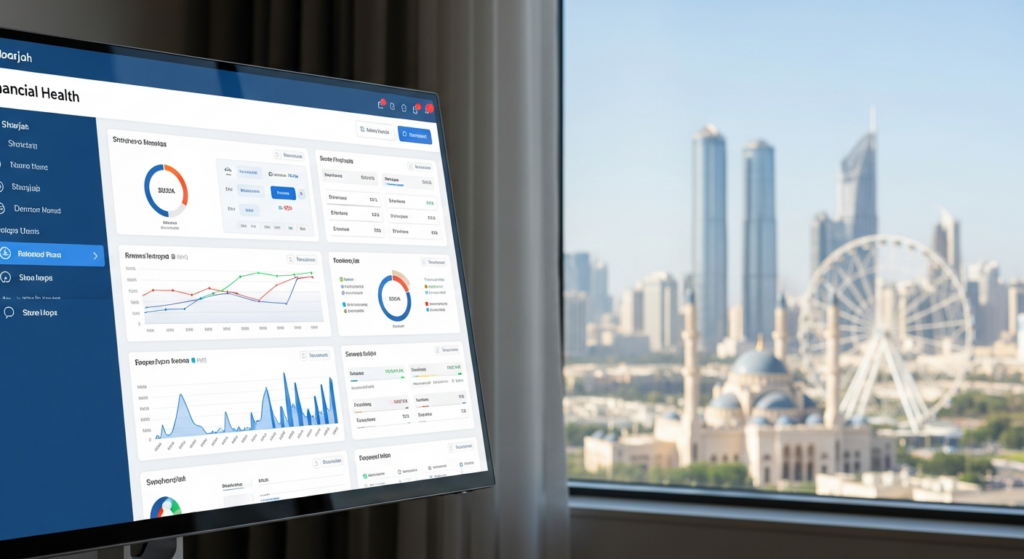
A financial health dashboard uses these indicators to provide investors with a comprehensive picture of the performance of properties in any given location.
The financial health dashboard looks at price momentum (if prices are rising or falling), rental strength (are rents going up or down? Is there high demand for tenants?), supply pressure (is new construction entering the market too fast? Is there a glut of units?).
It also looks at liquidity (can you buy or sell a property quickly? Is there enough transactions in the area?) and debt exposure (how much leverage is there in the market? Will changes in interest rates have an impact on the local real estate market?).
The financial health dashboard will help you understand your local real estate market better. You can see how your local market compares to other markets. You can use this information to make informed decisions about what types of investments are best suited to your investment goals.
Price momentum is an early sign of a trend. If prices are rising, but with increasing volatility (price swings) it may signal that speculators are entering the market. Conversely, if prices drop sharply after an increase it may mean that there was no underlying support.
Rental strength is not always well understood. While price growth may slow down, rentals can continue to produce cash flow. Rental yields are a key indicator of rental strength. Rental yield is calculated by dividing annual gross rent by the property’s purchase price. The higher the rental yield the stronger the rental market.
Comparing Sharjah Communities Through Data Insights
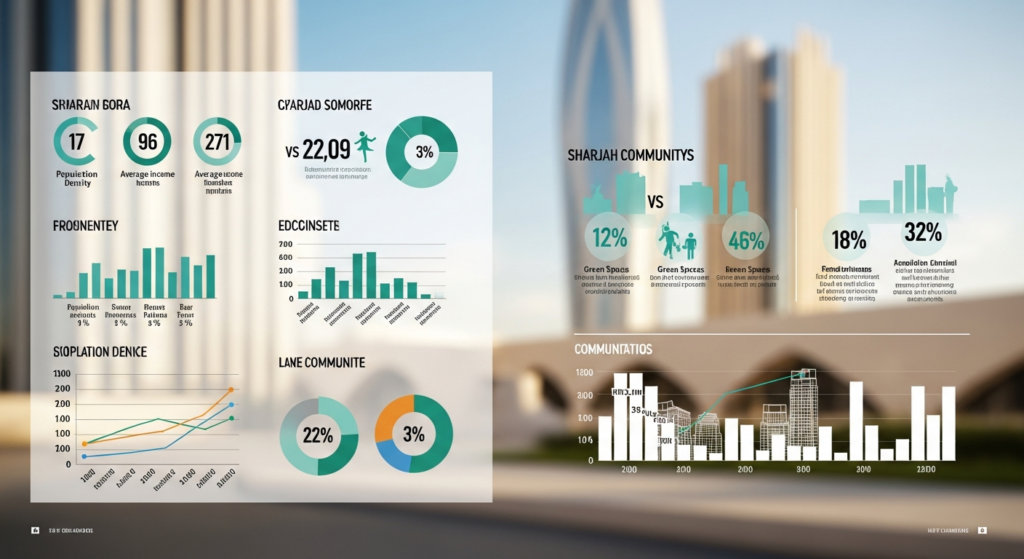
What makes this Financial Health Dashboard so effective is the comparison of different geographic areas. Sharjah has many different types of markets. Some are driven by local buyers (end-users), some by investors who buy with the intent of renting them out. Users can compare all of these different markets side-by-side to see which are performing best and which need more caution.
Example: A Waterfront Community may be showing a very strong Price Momentum, yet Moderate Rental Yields. Therefore, this would be an ideal place to invest in if your strategy is Capital Appreciation. On the other hand, a Suburban Area that has Lower Entry Prices and High Occupancy Rates would be ideal for investors looking for stable long-term Rental Income. The Financial Health Dashboard will help you quickly identify the differences between each of these markets.
One of the advantages of using a Financial Health Dashboard is Timing. Markets go through Cycles, and investing when they are in the correct cycle can greatly increase your returns. Investors can determine where the Market is within the Cycle by Analyzing Trends of the Five Key Indicators. This will allow investors to know whether their investment should wait until after the Market reaches the Peak before investing, or invest before the Market begins to Correct.
Insights from the Experts
Keyspace Realty and Keyspace Dubai utilize statistically-based methods to determine how every single component in a financial health dashboard for real estate impacts investment decisions for Sharjah and Dubai. Combining historical sales data, rental performance data and supply analysis, Keyspace enables investors to identify emerging opportunities and differentiate the neighborhoods by their stability and potential for growth.
Everything Sharjah is focused on providing local insight into community trends, lifestyles and demands throughout the Emirate; thereby allowing investors to better understand how real estate market conditions develop from a neighborhood perspective.
Applying the Financial Health Dashboard to Real Investment Decisions

Using a financial health dashboard involves much more than just analyzing data. A financial health dashboard will provide actionable insight that will allow you to make informed business decisions. An investor who identifies an area as having high rental demand with increasing supply would be able to use this information to determine whether it is a good time to invest in rental income and if it is likely to be a good long term investment.
Likewise, identifying an area as being a “balanced” market because it has improved liquidity and stable price growth indicates that it is a safe place to invest in residential or commercial property. Balanced markets are attractive to both end users and investors and therefore tend to have lower vacancy rates and more stable values. Investors who understand what these indicators mean can use them to guide how they conduct business.
Additionally, the financial health dashboard can assist investors with their portfolio planning. Rather than focusing all of your money into one area of town, the financial health dashboard allows you to allocate funds across many different towns with their own unique characteristics. The use of a financial health dashboard helps reduce the level of risk associated with investing and increases the overall value of your investment portfolio.
With the ever-increasing number of variables at play in the Sharjah real estate market, including new developments, shifting consumer preferences, and changes in the economy, the reliance on old-school methods such as simply using your gut instinct or intuition to make decisions regarding where to put your money will no longer work. As a result, using a data-based tool such as the financial health dashboard to help guide decision-making has evolved from being optional to being a necessity.
Frequently Asked Questions
What is a real estate financial health dashboard?
A financial health dashboard is an information-based tool that uses various metrics (i.e., price trend, rent, supply, liquidation and debt) to evaluate real estate markets.
Is a financial health dashboard important for investors?
Using a financial health dashboard will provide investors with a complete picture of the overall state of the market and eliminate their need to rely solely on one indicator.
Can a beginner use a financial health dashboard?
Many financial health dashboards are formatted to be easy to read and provide clear comparisons of location and trends to help a beginner quickly understand market conditions and how they may differ from other locations.
Should investors regularly check their financial health dashboard?
Investors should review their financial health dashboard frequently, particularly before making a purchasing or sale decision since market conditions will continue to evolve.
NOTE: Pictures used in the advertisement are for illustration purposes only.