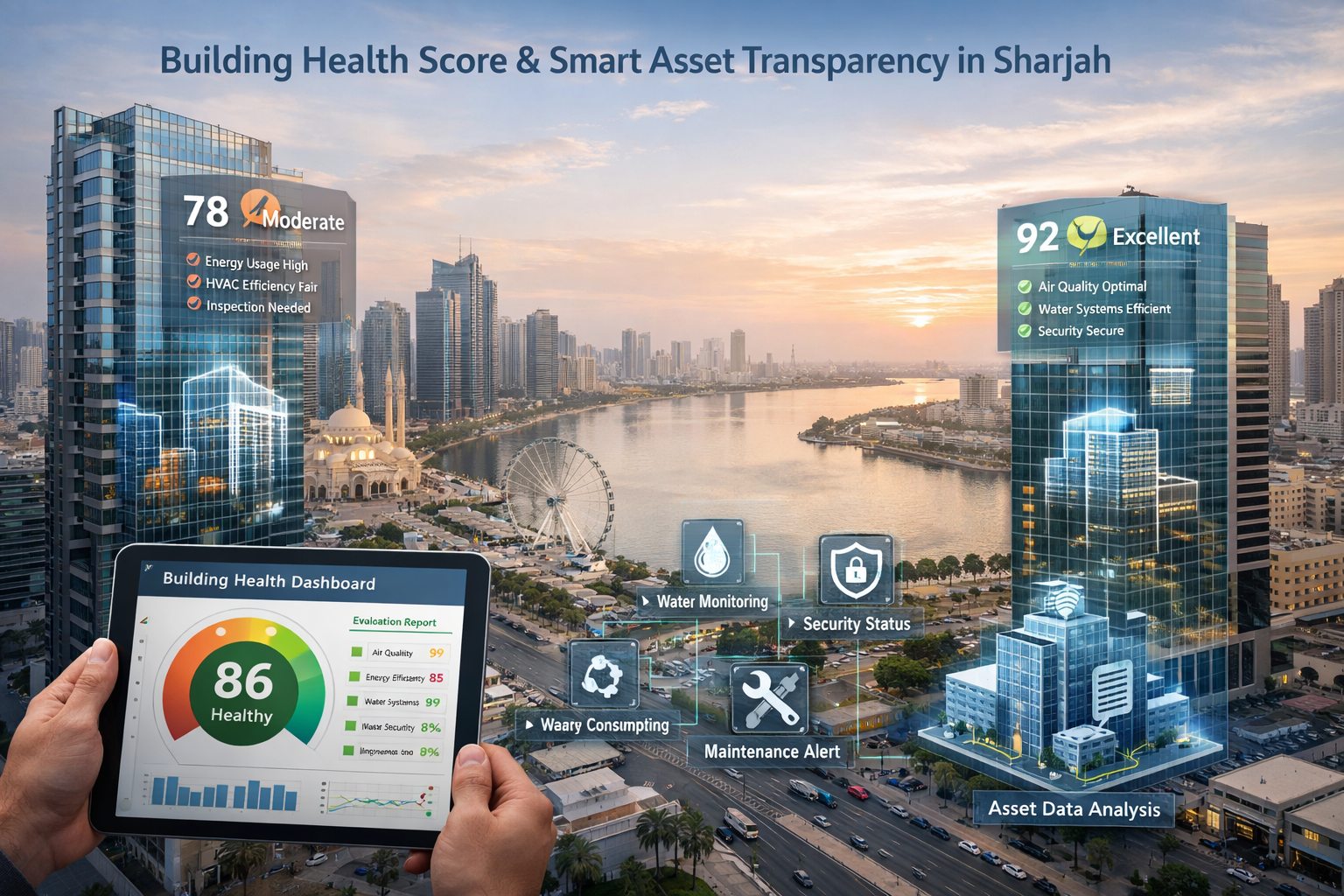
While the physical aspects of Sharjah’s property market have developed past the architectural features and locational benefits that once drew investors and tenants to a particular area, today it is their functional capabilities (operating reliably, measuring performance, and holding accountable) that are expected by both groups. Therefore, a health score framework, which takes a large amount of complicated data related to building operations and translates it into an easily understandable and performance-based score, answers those expectations and provides an answerable way to determine the operational capability of a building.
How Building Health Score Enables Real-Time Asset Transparency

Historically, traditional property management practices were primarily reactive and focused on how to respond after a problem occurred. For example, if the elevator broke down, the air conditioning was functioning poorly, or the water pressure was low, maintenance crews would only be called to respond after the issue had been reported. The consequences of these reactive responses include higher costs for both the owner and tenant and ultimately, loss of trust and loyalty from the tenants. On the other hand, a building health score represents a new proactive model of property management as it continually monitors core systems and identifies problems before they become larger issues and require costly repairs.
Monitoring Real-Time Data From Multiple Core Building Systems

One of the primary ways that a building health score provides a proactive approach to managing a building’s core systems is through its ability to aggregate real-time data from multiple core building systems, including but limited to; elevators, heating/cooling (HVAC), utility services and maintenance workflows into a centralized dashboard. Unlike traditional property management, where service records are typically kept separate from one another and inspected separately, a building health score allows the manager of the building to view a single, live operational report.
Elevator Monitoring Example
An example of how a building health score can provide a proactive approach to managing a building’s core systems includes the operation of elevator systems within multi-unit residential buildings. As a result of the high volume of usage that elevators receive on a daily basis, the systems are subjected to high levels of wear and tear. In addition to monitoring the frequency at which an elevator’s doors are opened/closed and excessive vibrations in the motor, the health score will also monitor the amount of power used by the elevator in order to identify possible problems as soon as they occur. As a result of the identification of potential problems prior to failure, the maintenance crew can schedule a service call in advance of the failure occurring, thus reducing the likelihood of the elevator breaking down and causing inconvenience to the tenants.
HVAC System Monitoring
HVAC systems require almost continuous monitoring throughout the entire year in Sharjah due to the extreme temperatures and humidity. HVAC systems have to perform within very specific parameters in terms of maintaining temperature to ensure comfort to the occupants and reduce costs related to operating the HVAC system. The extreme temperature and humidity climate of Sharjah makes HVAC systems one of the most important components to continuously monitor for optimal performance of the HVAC systems in order to maintain a comfortable environment for the occupants and reduce costs. If the cooling capacity of the system begins to decline, the health score can immediately flag the decrease in performance and allow the manager to take corrective action in order to prevent further degradation of the system, thus minimizing the impact to the occupants and the long term life expectancy of the equipment.
Utility Monitoring
Similar to the monitoring of HVAC systems, utilities are also monitored using a health score in order to monitor the consumption of utilities. For example, if a significant increase in water consumption is detected, it may indicate that there are leaks in the plumbing system. Similarly, if the electrical load exceeds normal ranges, it may indicate that a component is malfunctioning. Early detection of these types of issues can prevent them from escalating into expensive repairs.
Concealing Operations Behind Walls and Ceilings
Traditionally, buildings concealed the operational performance of the various systems installed within the building by hiding behind walls and ceilings. Thus, owners typically do not know of a problem until either a tenant complains or a system fails completely. However, the use of a health score removes the concealment aspect of a building’s operational performance by converting the raw data collected from each of the various systems into a set of measurable performance metrics.
Increasing Investor Confidence

Transparency regarding the operational performance of a building provides a number of benefits for the owner of the building. One of the most significant benefits is the increased confidence of investors who are interested in acquiring income-generating assets. With a growing number of buyers seeking documented evidence of the stable operational performance of their investments, the use of a health score provides a tangible tool for demonstrating the discipline of maintenance, the resilience of the building systems, and the level of control over operational risks.
Enabling More Accurate Long-Term Capital Budget Planning

By providing real-time monitoring of the performance of the systems installed within a building, a health score enables the owner of the building to develop more accurate forecasts of the remaining useful life of the equipment. Additionally, by enabling owners to plan for the replacement of equipment based upon actual performance data, rather than assumptions, the use of a health score enables owners to avoid unexpected expenditures and to stabilize their annual operating budgets. As a result, investors place a greater value on predictable outcomes and the use of a health score enables owners to demonstrate a greater level of predictability and to establish a greater degree of confidence in the financial modeling and valuation of their assets.
Providing Portfolio-Wide Benchmarking and Accountability
Asset managers and developers who own and manage multiple properties can utilize a health score to enable the comparison of operational performance across different properties. This enables owners to rapidly identify areas where specific systems are performing below optimal levels and to direct resources to address the root cause of the performance issues. Furthermore, a health score enables owners to hold their maintenance teams accountable for prioritizing their work based upon the severity of the performance issues identified and to hold themselves accountable for allocating sufficient budgetary resources to address the performance issues identified.
Supporting the Growth of Smarter Urban Systems in Sharjah
As Sharjah continues to evolve toward smarter urban systems, the expectations of tenants regarding performance transparency continue to grow. Tenants expect assurances that the elevators will function reliably, the cooling will be maintained at a consistent temperature, and the utilities will function properly. A building that uses a health score to provide a measurable assessment of its performance provides that assurance.
Additionally, developers who support their buildings with a measurable health score provide additional marketing leverage in comparison to developers who only make generic claims regarding the quality of their buildings. Rather than simply stating that their buildings are “of high quality,” developers who use a health score can provide quantifiable evidence of the reliable performance of their buildings.
Advisory, Market Insight, and Operational Intelligence
In a market in which transparency is increasingly viewed as a key component of value, collaboration between the operational monitoring of properties and the provision of advisory insights is essential. Keyspace Realty and Keyspace Dubai analyze assets beyond merely comparing prices, and evaluating the long-term resilience of the assets. In addition, Everything Sharjah provides community-level updates that impact occupancy behaviors and demand shifts. When a building health score is combined with advisory insights and local market intelligence, investors are able to obtain a complete picture of both the system reliability of an asset and the market positioning of the asset.
The Competitive Advantage of Measuring Performance
Transparency regarding the performance of smart assets provides clarity and precision to decision-making. When managers are able to measure the condition of a building’s systems in real-time, they are able to take timely and effective action. The elimination of downtime, reduction of operating expenses, and enhancement of regulatory compliance and stakeholder trust are just some examples of the numerous benefits of using a health score to measure the performance of a building’s systems.
As Sharjah continues to move forward with the development of its property market, buildings will compete increasingly based upon measurable performance metrics as opposed to mere aesthetic considerations. A structured health score framework will assist in ensuring that assets are competitively positioned, resilient and fiscally sound.
Removing Complexity Does Not Add It
Transforming real-time diagnostic information into actionable insights does not add complexity to a building’s systems. Rather, it eliminates uncertainty. Property owners who utilize health scores to measure the performance of their buildings protect the value of their buildings, improve the experiences of their tenants and create a stronger foundation for long-term investment performance.
Frequently Asked Questions
What is a building health score?
A building health score is a composite performance metric developed by aggregating real-time diagnostic data from multiple systems installed within a building, including but not limited to; elevators, HVAC systems, utility services and maintenance workflows. The performance metric developed by aggregating the data from the various systems installed within the building reflects the overall operational condition of the building.
How does a health score improve tenant satisfaction?
By continuously monitoring the performance of a building’s systems, a health score reduces the likelihood of unexpected system failures. Additionally, predictive maintenance helps to ensure that the elevators, cooling and utilities are operating properly, thereby improving the comfort and trust of the tenants.
Will a health score influence property valuation?
Yes. Documented performance data enhances investor confidence in the operational reliability and efficiency of the building. In the competitive property segments of Sharjah, documentation of a strong health score provides premium assets with a competitive advantage over average assets.
Are health scores applicable to all types of property?
Residential, commercial and mixed-use properties can benefit from the continuous diagnostic monitoring provided by a health score as all types of properties rely on mechanical systems and ongoing maintenance discipline.
Why is asset transparency important in Sharjah’s property market?
As Sharjah’s property market continues to mature, investors and tenants will continue to seek documentation of operational reliability and measurable efficiency. Therefore, transparency regarding a building’s operational performance will be a competitive advantage in the marketplace.
NOTE: Pictures used in the advertisement are for illustration purposes only.