
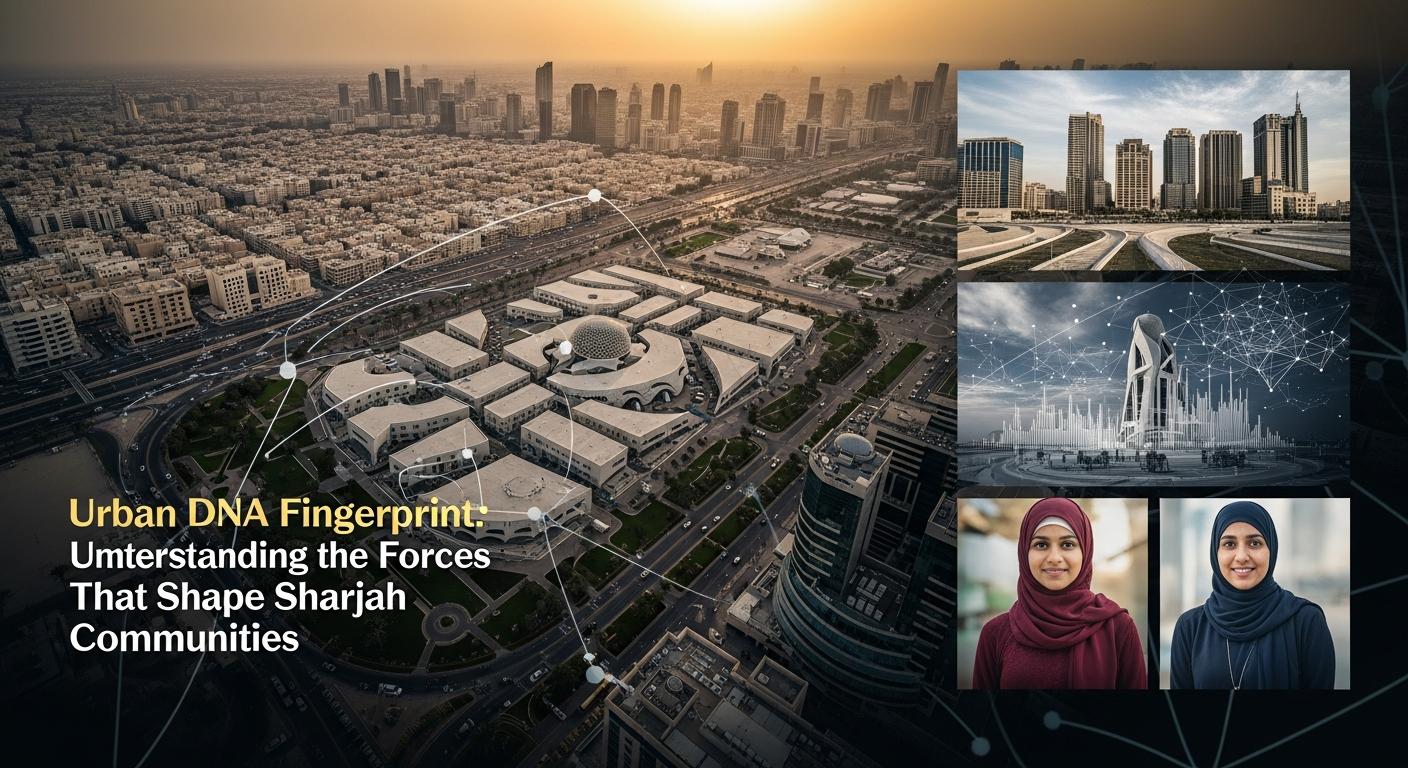
Sharjah’s real estate is usually described in terms of its price levels, active development projects, and investor interest; but what really happens as a neighborhood develops, and what drives it to develop — cannot be explained by the statistics alone. In other words, the urban DNA fingerprint explains why the people who live in some areas develop different identities from those in other areas, which in turn attracts specific types of residents and investors. In other words, when we study the ways in which a community develops (e.g., infrastructure, culture, demographics, lifestyle), we will have a much clearer understanding of how Sharjah’s communities are formed and why some communities remain popular.
What the Urban DNA Fingerprint Reveals About Sharjah Communities

The Urban DNA Fingerprint is an accumulation of the social (people), economic (jobs), and environmental (physical) characteristics of a given area, which creates the unique “identity” for a specific area as it develops through time. This framework is particularly helpful in understanding the uniqueness of Sharjah’s districts, as there are distinct areas such as historic districts, residential neighborhoods along the waterfront, educational districts, and rapidly developing residential corridors. These components come together to create a distinct community character that defines the long term look of each individual neighborhood.
The urban DNA fingerprint is also influenced by the infrastructure of a given area. Roadways and highway systems, public transit options, access to job centers, proximity to schools and health care facilities, etc., all contribute to how an area will develop into a community. A number of factors can influence where working professionals choose to live based on their commute. For example, if a working professional has the opportunity to work from home, or has an option to work at a location close to their residence, this may encourage them to locate closer to their employer. Infrastructure investments can promote growth within adjacent residential districts; therefore, infrastructure investment contributes to the development of the local urban DNA fingerprint.
Key Elements That Shape the Urban DNA Fingerprint
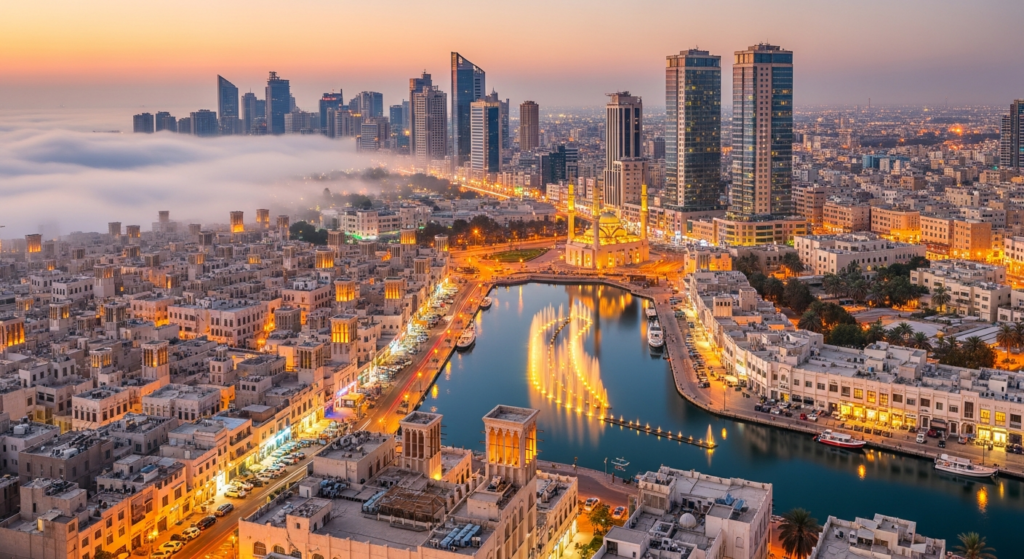
The significance of community identity is equal to the significance of individual identity in defining the culture of a community. For example, Sharjah is well-known for its emphasis on preserving heritage as well as promoting and educating people about the importance of education and the cultural development of the emirate. Therefore, when a neighborhood has museums, a cultural district, a university or college within it; it will have a totally different character than an all residential neighborhood. In addition, families, educators, and other creative professionals are drawn to these neighborhoods which give them a sense of being surrounded by the intellect and cultural environment of the emirate. As a result of the long term commitment of these groups to the neighborhood, a strong cultural layer is developed which ultimately becomes a major portion of the urban DNA fingerprint of the community and gives definition to how the community is viewed.
In addition, demographic trends significantly contribute to the way a neighborhood develops. Options available for housing, pricing for properties and availability of local amenities determine what type of residents an area will attract. Some communities attract young professionals that require a short commute to their workplace and want easy access to entertainment opportunities while other communities are more attractive to families that want quality schooling, large parks and plenty of space for their homes. These demographics continue to be part of the urban DNA fingerprint over time due to the fact that they determine what types of businesses, service providers and facilities are attracted to the area.
Finally, lifestyle preferences play a significant role in the formation of the identity of Sharjah’s neighborhoods. For instance, waterfront neighborhoods provide an opportunity for residents to enjoy water views and participate in various forms of outdoor activities. Neighborhoods surrounding universities often become vibrant environments full of students, coffee shops and study spaces. Ultimately, the accumulation of lifestyle choices of residents of the area contributes to the lifestyle element of the urban DNA fingerprint and makes each community unique from one another.
Urban DNA Fingerprint and Real Estate Investment Insights

Investors in today’s globalized economy have become increasingly interested in understanding the Urban DNA Fingerprint as a way to understand how different areas behave within a property market. Rather than just looking at how prices are changing in the short term, savvy investors examine what is causing the changes in a community or neighborhood and thus ultimately drive long term value in the area.
Examples of Sharjah’s various communities demonstrate a clear example of this phenomenon. Many waterfront communities remain highly attractive to families looking for leisure activities and/or lifestyle amenities such as shopping centers and restaurants. Academic districts in Sharjah consistently experience high demand for residential rentals due to students seeking temporary accommodations near universities. Families with young children continue to seek out established family neighborhoods that provide access to quality schools, healthcare services and parks. These types of neighborhoods all have their own unique Urban DNA Fingerprints which influence their long term performance in terms of property values.
When designing new communities, developers follow a similar process. They research the Urban DNA Fingerprints of the surrounding districts so they can develop properties that meet the demands of potential buyers/renters. For instance, a developer may build a “family” focused community which includes parks and schools; whereas a community built using a mix use model (residential and commercial) would focus on walkability, proximity to shopping centers, and access to public transportation.
Technology and Data in Mapping Sharjah’s Urban DNA
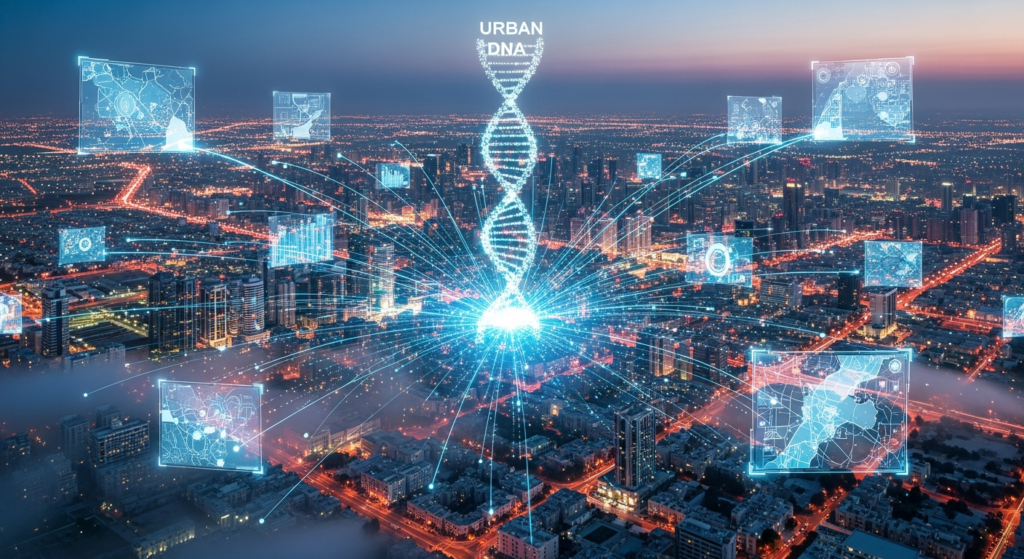
Modern methods of analyzing data have improved the ability to determine the urban DNA of different neighborhoods through the use of advanced analytical software. The software tracks the movement of people, the development of infrastructure, the demand for housing, and lifestyles as well as other indicators of community evolution, providing planners and investors insight into the ways in which communities are evolving over time.
The technology used to track neighborhood interaction allows planners to see how improvements in transportation infrastructure connecting previously separated areas of a city will gradually influence the urban DNA of those two areas. As transportation becomes more accessible, residents may be able to explore additional housing opportunities in nearby districts (previously thought to be located beyond the reach of employment centers) to name just one of many examples.
Planners utilize the data collected through these technologies to develop and implement comprehensive development plans for communities. By understanding the urban DNA fingerprint of an area’s current communities, planners can design districts or communities that will enhance the quality of life of the existing surrounding community and support continued urban growth in Sharjah while maintaining the cultural integrity of the community.
Insights from the Experts
The websites for Sharjah real estate companies, Keyspace Realty and Keyspace Dubai, provide a clear understanding of how urban DNA fingerprints shape neighborhoods in Sharjah and influence their growth and characteristics. We provide valuable insights based upon property analysis, local market reporting and research-based reporting that inform buyers, renters and investors about the larger influences impacting Sharjah’s real estate markets. We provide a comprehensive view of how the combination of on-the-ground observations and property data from our platforms can be used to assess how infrastructure development, demographic trends and lifestyle behaviors impact the urban DNA fingerprints of Sharjah communities and ultimately their long-term investment potential.
Everything Sharjah also provides an important resource for information on lifestyle trends, local developments and community news throughout the Emirate of Sharjah. It provides a platform for readers to gain insight on how consumers’ daily living habits and cultural norms are developing in Sharjah and how they are being influenced by emerging sub-districts.
Why the Urban DNA Fingerprint Matters for Residents
For residents, understanding the urban DNA fingerprint helps identify communities that align with personal lifestyles and priorities. A family might prefer neighborhoods with parks, schools, and healthcare facilities nearby. Professionals may look for districts that offer easy access to workplaces and entertainment options. Recognizing these patterns makes it easier to choose a community that supports daily routines and long-term comfort.
As Sharjah continues to expand, new districts will develop their own identities based on infrastructure investment, cultural influence, and demographic changes. Over time, these factors form distinct patterns that become part of the city’s evolving structure. The urban DNA fingerprint provides a valuable lens for understanding how Sharjah communities grow, adapt, and maintain their unique character.
Frequently Asked Questions
What is an urban DNA fingerprint in real estate?
An Urban DNA Fingerprint defines the Urban Character of a Community through Demographics, Cultural Identity, Lifestyle Trends, Infrastructure and other factors.
Why is the urban DNA fingerprint important in Sharjah?
This provides insight into which neighborhoods are most attractive to residents and investors and ultimately will grow over time and drive demand for Property.
How does infrastructure influence the urban DNA fingerprint?
Infrastructure, such as Highway Systems, Transportation Networks, Schools, Commercial Centers etc. provide Accessibility and Convenience and thus shape how Communities Develop.
Can investors use the urban DNA fingerprint to choose property locations?
Yes. Investors utilize these patterns to locate Areas with Strong Long-Term Demand and Sustainable Growth In Property Value.
Does every neighborhood have a unique urban DNA fingerprint?
Yes. Each community develops its own identity based upon Location, Lifestyle Preferences, Demographics and Infrastructure Development.
NOTE: Pictures used in the advertisement are for illustration purposes only.